Ask ten returning visitors where to stay in Tokyo and you'll get ten different neighborhood names, most defended with real conviction. That isn't because any one area is objectively best. It's because "best" depends on which stations you'll be moving between and how much luggage-hauling and platform-switching you're willing to do to get there — and the neighborhood photo on a booking site tells you almost nothing about that.
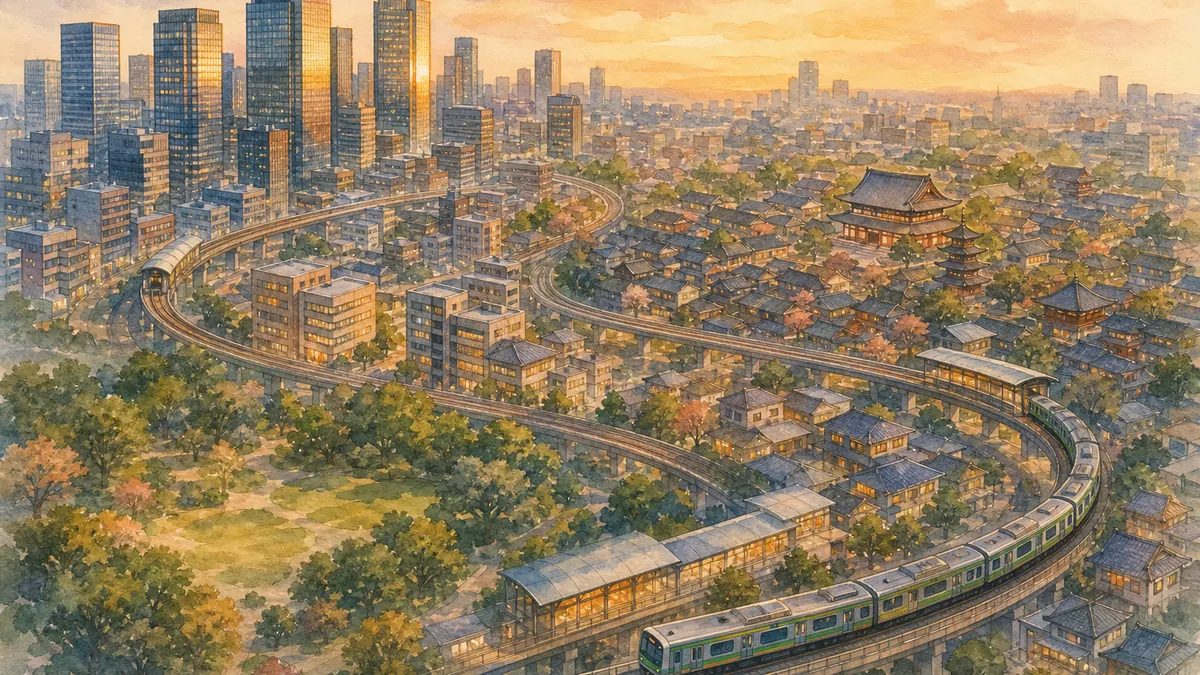
Start With the Trains, Not the Neighborhood Name
For a first trip to Tokyo, the decision that matters most isn't which neighborhood looks best in photos — it's how many train lines connect your hotel to the places you'll actually go. Tokyo's rail network is comprehensive but not uniform. Some stations sit on a single line; others sit at interchanges where four or five lines converge. The difference shows up every day of the trip, not just once.
The JR Yamanote Line is the reference point most visitors end up using, whether they realize it or not. It's a loop line that connects most of the neighborhoods people actually want to visit — Shinjuku, Shibuya, Tokyo Station, Ueno, and more — without a transfer between them. A hotel within a short walk of a Yamanote station puts you one line away from a large share of your itinerary. A hotel two subway changes from the nearest Yamanote stop can still work, but it adds friction to every outing, and that friction compounds over a week.
The other variable worth checking before you book: the walk from the station exit to the hotel door. Tokyo stations are often enormous, with a dozen or more numbered exits leading to different streets. A hotel listed as "two minutes from the station" can still mean a genuine ten-minute walk if you exit on the wrong side, or a long underground corridor with stairs if you're hauling large suitcases. Check which exit is nearest and whether the route is street-level before you confirm a booking.
Tokyo's Main Areas for Visitors
Each of Tokyo's major hotel neighborhoods has a distinct rail profile and a distinct feel. None of them is wrong for every trip — they suit different kinds of trips.
Shinjuku
Shinjuku Station is one of the busiest rail interchanges in the world, serving six JR lines (Yamanote, Chuo Rapid, Chuo-Sobu, Saikyo, Shonan-Shinjuku, and Chuo limited expresses), the Odakyu Odawara Line, the Keio and Keio New lines, two Toei subway lines (Shinjuku and Oedo), and one Tokyo Metro line (Marunouchi). That density means a Shinjuku hotel puts almost everywhere in the city within reach, often on a single line. It's also a large, dense entertainment and dining district, with the nightlife of Kabukicho on one side and a calmer high-rise hotel district to the west. The tradeoff is scale — the station itself can be disorienting on a first pass, and the area rarely feels quiet.
Tokyo Station and Marunouchi
Tokyo Station is Tokyo's main Shinkansen terminal — the Tokaido line west, and the Tohoku, Yamagata, Akita, Joetsu and Hokuriku lines north — which makes it a natural base for anyone planning day trips beyond the city. The Marunouchi side is a business district — wide streets, glass towers, a calmer register than Shinjuku or Shibuya once offices close. It sits on the Yamanote Line and several subway lines, though there's less happening at street level in the evening.
Asakusa
Asakusa sits on Tokyo's east side, built around Senso-ji temple and its surrounding streets, and reads as the most traditional-feeling of the major hotel areas. It's generally more affordable than the west-side districts. Rail connections — the Ginza and Asakusa subway lines, plus the Tobu line toward Nikko — are solid but not as dense as Shinjuku or Tokyo Station. The practical tradeoff is distance: Asakusa sits farther from Shibuya, Shinjuku, and the west-side sights, so getting there and back eats more of the day.
Shibuya
Shibuya anchors the shopping and youth-culture side of Tokyo — the scramble crossing, the department stores, the density of small restaurants. It sits on the Yamanote Line with strong subway and private-rail connections, including the Tokyu Toyoko Line running south to Yokohama. It shares Shinjuku's downside of being busy and loud, particularly around the station in the evening.
Ueno
Ueno is one of the better-value hotel areas, with a large park, several major museums, and a zoo within walking distance. Its rail profile has one specific advantage for arrivals and departures: the Keisei Skyliner runs nonstop to Narita Airport from Keisei Ueno, an underground station operated by a different company a short walk from the JR one — worth knowing before you plan a tight connection. Ueno is also on the Yamanote Line, so the rest of the city stays reachable.
Ginza
Ginza is Tokyo's upscale shopping and dining district — central, well-served by subway, and noticeably quieter at night than Shinjuku or Shibuya once the department stores close. It suits travelers who want a calm, central base without needing to be inside a nightlife district. Rates here tend to sit at the higher end of the market.
| Area | Best for | Rail notes |
|---|---|---|
| Shinjuku | First-timers, nightlife | Major interchange — six JR lines, Odakyu, Keio, Toei Shinjuku/Oedo, Tokyo Metro Marunouchi |
| Tokyo Station / Marunouchi | Day trips beyond Tokyo, business travel | Shinkansen terminus; Yamanote Line; quiet evenings |
| Asakusa | Budget, traditional atmosphere | Ginza and Asakusa subway lines, Tobu line toward Nikko; farther from west-side sights |
| Shibuya | Shopping, day trips south | Yamanote Line plus the Tokyu Toyoko Line toward Yokohama |
| Ueno | Budget, museums, Narita-airport itineraries | Yamanote Line; Keisei Skyliner to Narita from adjacent Keisei Ueno |
| Ginza | Central, upscale, quiet evenings | Subway-served; nearest Yamanote stops are Yurakucho and Shimbashi |
If you're not confident choosing among these by name, a simpler heuristic works: pick a hotel within a short walk of any Yamanote Line station. The loop won't put you everywhere directly, but it keeps you within one transfer of nearly everything travelers care about — a reasonable trade for not having researched every neighborhood in depth.
Wherever you land, staying reachable matters off the train as much as on it. A working data connection makes it easier to navigate transfers, confirm a same-day booking change, or reroute around a delay.
Matching the Area to Your Trip
For a first Tokyo trip, staying near the Yamanote Line reduces daily decision-making — most things end up one line away, so you can improvise more and plan less. Shinjuku, Shibuya, or Tokyo Station all work well for this.
Traveling with family, prioritize space and fewer transfers over neighborhood name. A single transfer with children and luggage costs more time and patience than it does with a solo backpack. Ueno or the calmer parts of Tokyo Station and Marunouchi, where family-sized rooms tend to be more available, generally work better than the tightest, busiest blocks of Shinjuku.
If budget is the main constraint, Asakusa and Ueno generally offer more room for the money, with a strong supply of capsule and business hotels alongside standard rooms. The tradeoff is a few extra minutes on the train to reach west-side sights — usually a reasonable trade for a lower nightly rate.
If nightlife is a priority, Shinjuku and Shibuya are the obvious choices — both have dense concentrations of bars, izakaya, and late options within walking distance of the station, so getting home doesn't depend on catching a specific train.
If your itinerary is airport-heavy — an early flight out, a late arrival, or multiple domestic legs — the airport you're using matters more than any other factor. For Narita-heavy trips, Ueno or Nippori put you on the Keisei Skyliner with a direct run to the airport. For Haneda-heavy trips, the two routes start from different places: the Tokyo Monorail runs from Hamamatsucho, and the Keikyu Airport Line runs from Shinagawa. Tokyo Station is on neither, so base yourself near one of those two rather than at the Shinkansen hub.
Before You Book, Check the Walk
Once you've narrowed to a neighborhood, the listing itself deserves a second look. "Near [station name]" is doing a lot of work in a hotel listing, and it isn't always precise about the actual walk.
Search the hotel's address alongside the station map, note which exit is closest, and check whether the route is flat or involves stairs. Several Tokyo stations sit below or above street level, and dragging luggage down two flights at the end of a travel day is worth avoiding if you can plan around it.
It's also worth weighing a hotel one stop off a major hub rather than directly on it. A room a single stop from Shinjuku or Shibuya is often meaningfully cheaper and quieter, while adding only a few minutes and one predictable train ride to the commute. That trade tends to look better in practice than it sounds on paper, and it's one of the more reliable ways to improve a Tokyo hotel budget without giving up transit access altogether.
None of this requires knowing Tokyo before you arrive. It requires treating the station, not the neighborhood name, as the unit you're actually booking around.